
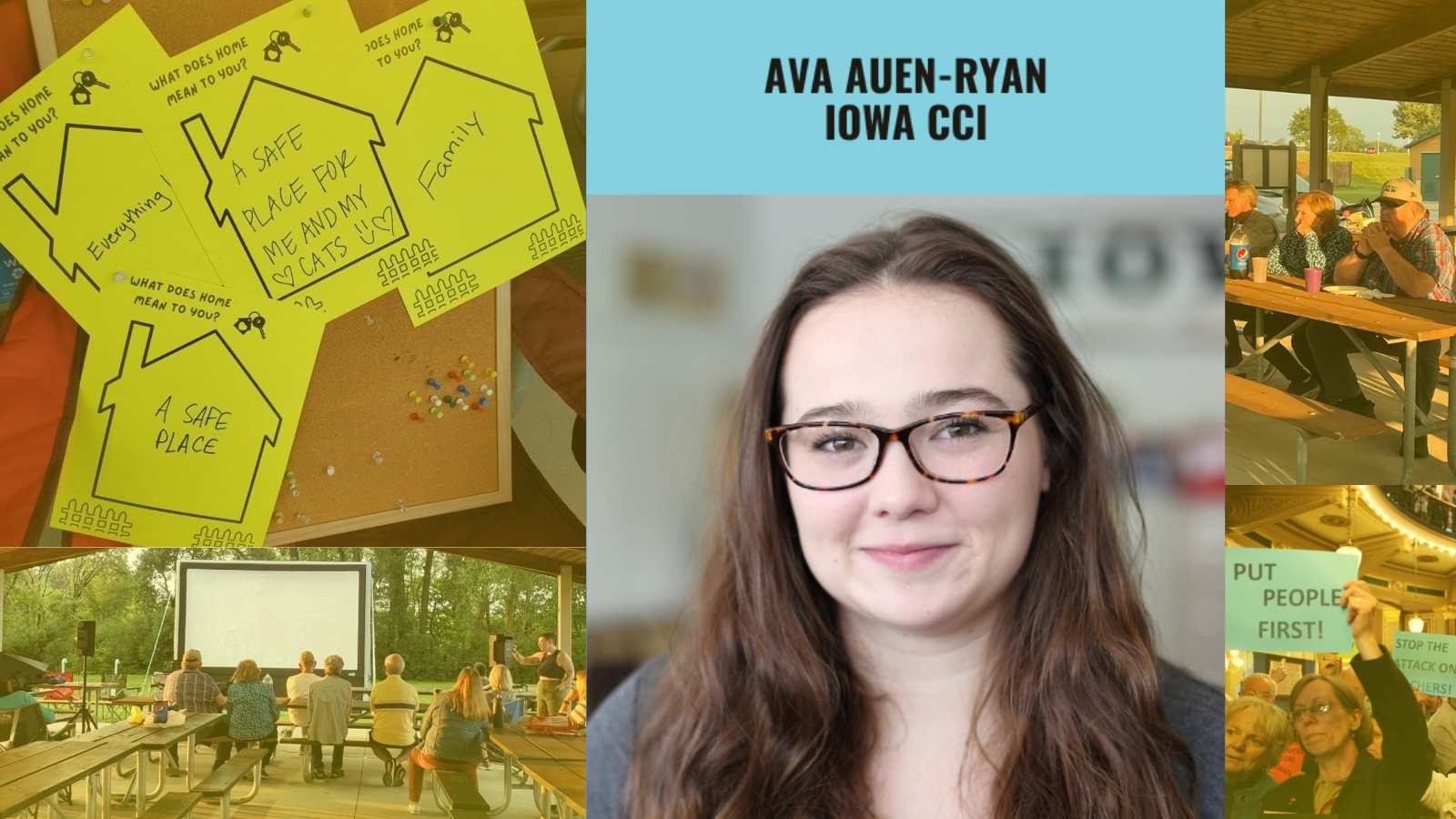
How do film screenings build community in rural and small towns? Andy Myers, Director of Campaigns and Strategy, chats with Ava Auen-Ryan, community organizer with Iowa Citizens for Community Improvement (Iowa CCI). They discuss how relationship building is at the center of rural organizing. Leading with intentionality, organizers can use the power of story and community film screenings to bring people into their membership base and build power to create social change.
Andy: I always think of film as a great tool specifically for organizers that work with the people. Films are good at bringing in more people to the work, can you start by sharing more about your work and what Iowa Citizens for Community Improvement does?
Ava: Sure, we are a multi-issue organization, and our overall North Star is to organize to win solutions that make life better for people. It can look like having a campaign around police reform in Des Moines, or housing work in Dubuque, or the work I did with Rural Cinema focusing on the environment, our land, AND our water, specifically in rural communities in Iowa. We’ve been working to stop a proposed CO2 Pipeline, and are in year 3 or 4 of the campaign and they have not been able to build it or get their permits. And we also work on issues related to factory farming, industrial agriculture, and how it’s impacting our water, and how farmers are being impacted by consolidation within agriculture.
We are a membership organization, and that is really important to us. And so we have member leaders for all of our campaigns. So for example, in North Central Iowa, we work in about a four county radius and in Mitchell County, we have a group of six to ten key leaders who help us make decisions about how we engage their community aroundwhat we’re trying to fight for, so we do a lot of meetings. We do big community meetings where people show up to learn more, and we offer people ways to get involved. We do smaller planning meetings. We’ll do meetings with elected officials to learn more about where they’re at and figure out how we approach them around the solutions we need. We also do one-on-one meetings with people. Basically, the name of the game is talking to people as much as possible to learn what they care about, and then connecting that to the issues and trying to find ways for people to plug in. So, a good way to get people to plug in can be coming to a film screening. So lots of just trying to spend as much time talking to people as possible and building those relationships.
 Andy: And why do you think working with people is the way to do all of this?
Ava: I think there’s no other way to sustain real change over a long period of time. It can be hard sometimes, especially in the political climate we live in. But I think most people are good people who have a lot of shared values and care about the same things. But if we’re not talking to each other, like it’s really easy to write each other off and that just leads to divisiveness that only benefits the current system we’re in. With the pipeline for instance, if we weren’t talking to each other, that’s what Summit Carbon Solutions, the pipeline company wants, right? Because then they get to put their pipeline in and they get to make billions of dollars each year. We need each other. Humans are pack animals! I think it’s the only way we can actually win solutions and then sustain them over time.
Andy: Definitely agree with all of that. Can you share how Iowa CCI uses film to work with people in this way, and bring more folks into the work?
Ava: When we started working with films, we used them kind of sporadically. We didn’t have a huge strategy around it, but we really believed in art and moving people and inspiring people, and then we got involved with the Rural Cinema program and tried to make it a lot more intentional. And our main drive was to meet new people and to bring them into the work with different asks. We like to think of all of our asks, as a light, medium, and heavy ask. And coming to a film screening is a light ask. If instead, you just meet someone, and ask them to show up to the Capitol to lobby all day–that’s probably not a good ask, right? Because they just met you. They’d have to drive three hours. Then they have to spend all day with you. It’s a lot to ask someone right away. But coming into a film screening in their community is a lot lighter of an ask and it’s a way to keep building that relationship. So that’s kind of how we were trying to strategize around using film in Rural Cinema. And that’s how we still think about it. At the screenings themselves, we can introduce medium and heavy asks. At one of our film showings, we were knocking doors around that time, which is a big ask–you’re going to go knock on a stranger’s door and ask them to sign this petition about this thing?!--that’s kind of scary for most people. But that was something that we asked people to do at that film screening. We probably wouldn’t ask that normally, but it was an easier ask since they had done the light ask of attending the film screening.
In terms of films that we use, there are two main categories that we lean on quite a bit. One is films that have a very clear villain and a very clear movement of people who are trying to prevent something from happening. And with those films, it could be about any issue and you could apply it to the situation that you’re in and learn and find similarities. Kind of those David and Goliath stories or organizing stories. The other bucket that we lean on heavily are films that offer an alternative, films that show the vision of what we’re fighting for. People in the audience will often see things or make connections that we don’t anticipate. Films help show the commonalities we have, even if we don’t live in the same place or if we don’t look the same, or there’s a lot of things we have in common—the enemy is not each other.
Andy: Earlier you had shared that part of why you work with people is because we need everybody or we need at least a lot of people to get our stuff done and build actual movements. Have you ever used films to bring in folks that might not yet be “with you”?
Ava: Yeah, so one good example would be the pipeline fight. There’s a lot of reasons to care about this issue and kind of the reason that people got worked up about it at first was property rights and eminent domain. But we don’t want to stay just there. We want to expand the issue and talk about how it’s impacting the land and our water. And also, you know, climate change and how this is a false energy solution. There’s other things that we should be investing in. And we’re working primarily in rural Iowa. If you look at Mitchell County, it’s overwhelmingly older white folks and probably folks who are more conservative than maybe we are. And so we showed ‘LN3: The 7 Teachings of the Anishinaabe Resistance.’ It showed a fight led by indigenous people and in the film they talked a lot about their experience and their perspective and the solutions that indigenous cultures offer to the climate crisis and that’s just a different experience that the folks we’re working with don’t have. People learn through experience and through repetition, so showing the film was offering someone an experience to learn about something that otherwise, they would have never gotten to see or learn about. And some of these people might not believe in climate change, but they care about the land, or they care about the water. They care about all these things but climate change might not be something they talk about. With this film, the climate change connection was relatively explicit, and it showed we can talk about this and it’s going to be okay.
Andy: With Rural Cinema, there is a deeper commitment of time and energy. Y’all have to learn the equipment, you have to do the trainings, and then you do a whole film series. Why did you invest so much time and energy into films as a tool for your organizing?
Ava: It goes back to offering opportunities for all of us to learn. We all always have something to learn and it’s a great way to do that. And then two, just going back to those “lighter asks” where we know not all of the different tactics or activities we do fit people’s skill set or interest. So this is one that I think pretty broadly, people are comfortable with, they want to learn more. So yeah, it kind of just goes back to its one of those lighter asks that can get people in the door and get them to stick with us long term.
With films, it’s also emotional. It’s a piece of art. It can move you in a way where a typical conversation may not. There’s other “light asks” we could ask people to do and they would do them, but it doesn’t have the same emotional reaction or connection that a piece of art can bring. We have lots of creative people on staff. I can be creative at certain times. And also sometimes it’s hard. So we’re grateful that people create things like this that we can utilize. Especially for staff or member leaders who have been involved, we think about this stuff all day long and it can be really easy to compartmentalize and this reminds you of what’s at stake and “the why” behind doing all the work. And I think that’s super important to keep going. And I think keeping going is the most important thing we can all do right now.
If you’re interested in learning how to put film to work for community change and inspire others to take action, join us for our Story Leads To Community webinar on July 30, 2025, at 3 PM EST. Register here. For more on Rural Cinema, check out the Rural Cinema project page. Applications for the 2026 cohort will open this winter. To learn more information on Ava and the important work of Iowa CCI, check out their site at this link.